More than 60% of the world’s desalinated water still comes from heating seawater and cooling the vapor. Thermal processes are a small model of the natural water cycle: evaporate, move the vapor, condense.
Why lower the boiling point?
Industry rarely pushes water all the way to 100°C. It lowers the pressure so water boils cooler. That enables multi-effect distillation and helps control scale. Carbonates and sulphates in seawater — gypsum above all — drop out near 95°C and form a hard layer on tubes and walls. Keeping temperature below that limit slows fouling.
Thermal plants generally cost less to maintain than they do to build, deliver very pure water (TDS sometimes below 10 ppm), send out brine with fewer chemicals than RO, and pair well with steam or gas power stations. The main drawback is capital cost, especially for MSF, which uses expensive alloys.
Multi-stage flash (MSF)
MSF became commercial in the 1950s. Seawater is both the feed and the condenser coolant. After pretreatment it enters the last effect, is heated, is degassed, and circulates back through the effects to a brine heater that raises it to about 90–120°C. In each lower-pressure stage some water flashes and condenses on the feed tubes. Large plants run 8 to 20 effects.
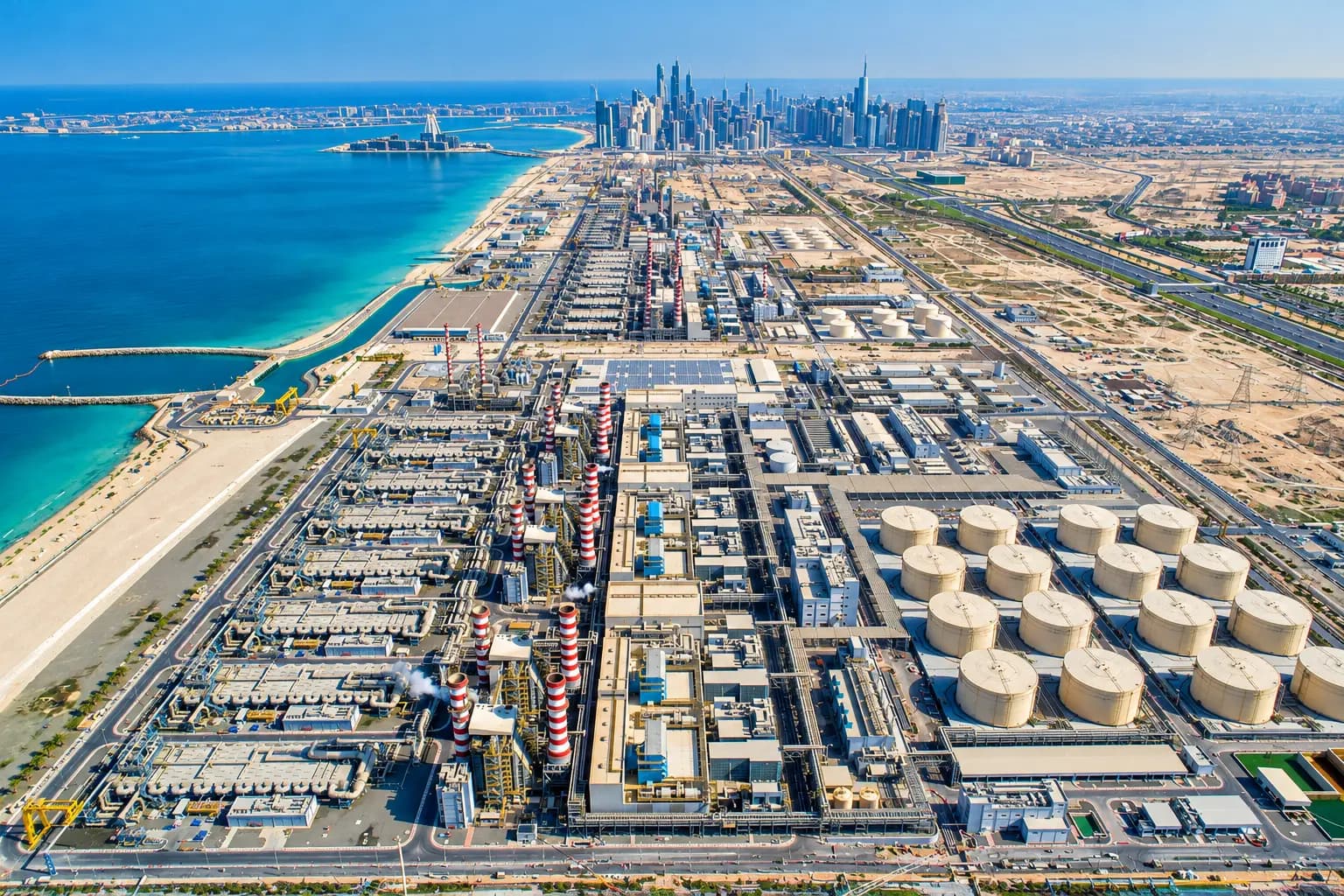
The largest units produce more than 600,000 m³/day. About 40% of global desalination capacity has been MSF, and more than 80% of those plants sit in Saudi Arabia, the UAE and Kuwait. One Iranian example is the 12,500 m³/day plant in Chabahar.
Recovery is low: roughly as much concentrated brine leaves as product is made, and plants typically run at 70–80% of nameplate capacity. The distillate is so pure it must be blended with a little seawater and dosed with lime, fluoride and similar minerals before it is drinkable.
Multiple-effect distillation (MED) and vapor compression
MED looks like MSF, but brine is sprayed onto steam tubes. Vapor from the first effect condenses in the second and that heat evaporates more water. Operating temperature is often below 70°C, so scaling and corrosion fall and electricity use can be under 1 kWh/m³. In recent decades MSF replaced MED on many large schemes because the cost per cubic metre was lower.
Vapor compression suits small and medium plants of 20–2,000 m³/day. A compressor pulls a partial vacuum, collects vapor and routes it through tubes in the feed so the vapor both condenses and heats the incoming water. Mechanical vapor compression (MVC) is usually single-stage. Thermal vapor compression (TVC) is multi-stage, more efficient, and has been designed up to 20,000 m³/day. The package is compact — even portable — but start-up needs an auxiliary heater.
Solar MEH and MES
MEH takes evaporation heat from solar collectors and raises water to about 85°C. Several units operate in Jeddah; one with 140 m² of collector area makes about 5 m³/day. Low output and the need for sunny land are the main limits.
MES was designed for hot deserts. It stores water at 50–70°C in ponds, blows air through an evaporator and condenses the saturated air. A sample plant has produced up to 680 m³/day in summer at 71% recovery and about 2.6 kWh/m³.